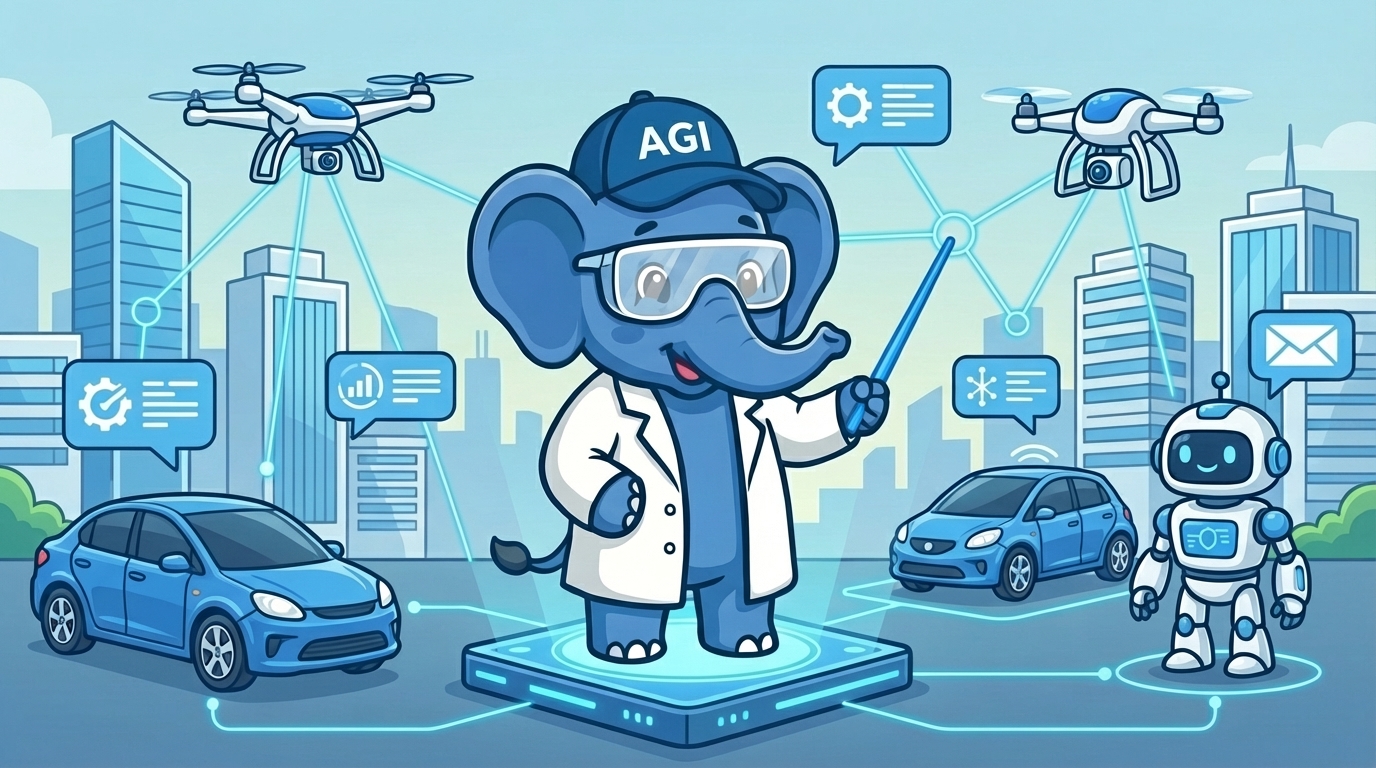
We’ve been thinking about AGI wrong.
The dominant narrative is that AGI will emerge from scaling up a single model - more parameters, more compute, more data. But what if intelligence doesn’t need to live in one place? What if it emerges from connection?
The Satya Nadella Insight
In a December 2024 interview on the BG2 podcast, Microsoft’s CEO made a prediction that stopped me in my tracks:
“Business applications are essentially CRUD databases with a bunch of business logic. The business logic is all going to these agents, and these agents are going to be multi-repo CRUD. They’re not going to discriminate between what the backend is, they’re going to update multiple databases and all the logic will be in the AI tier.”
Read that again. Multi-repo CRUD.
Nadella isn’t describing a future where one AI knows everything. He’s describing a future where AI agents query multiple databases, update multiple systems, and orchestrate across boundaries that humans couldn’t cross without months of negotiation.
Collective Intelligence
What if AGI looks less like a brain and more like a nervous system?
Consider how human intelligence actually works. Your brain doesn’t store everything - it relies on external systems. Books. Databases. Other people. The internet. Intelligence is distributed across a network of specialized knowledge sources, connected by protocols that let them communicate.
Now imagine AI agents doing the same thing:
In the network model:
- Specialized agents know their domain deeply
- Queries flow between agents automatically
- Payments compensate data providers fairly
- No single point of failure - the network routes around problems
This isn’t science fiction. This is what Satya is describing. And it’s happening now.
The Missing Infrastructure
There’s just one problem: the infrastructure doesn’t exist yet.
Today, if Agent A wants to query Agent B’s data:
- Someone negotiates a business deal
- Legal reviews the contract
- Engineers build a custom integration
- Months pass
- Maybe it works
This is insane. The web was supposed to be interconnected. Instead, we built silos.
For network intelligence to work, agents need:
- Instant data access across applications
- Automatic payments for every query
- No human negotiation required
- Trustworthy data with verifiable provenance
This is why we built OnDB.
Multi-Repo CRUD in Practice
Let’s make this concrete with two examples.
Example 1: Treasury Management
An AI agent managing corporate treasury needs to optimize cash positions across accounts:
Agent: "Rebalance treasury to minimize idle cash while maintaining 2-day liquidity buffer"
To execute this, the agent needs to:
- Query current balances across multiple banks
- Pull upcoming payables from the ERP system
- Check receivables pipeline from the CRM
- Get real-time FX rates from market data providers
- Access yield curves for short-term instruments
Today, treasury teams spend hours in spreadsheets pulling data from disconnected systems. An agent with access to a unified data layer does it in seconds - and every data provider gets compensated.
Example 2: Supply Chain Intelligence
An AI agent optimizing procurement decisions:
Agent: "Find alternative suppliers for component X with <14 day lead time and comparable quality scores"
All providers compensated
One query. Multiple data sources. Automatic payments. No negotiation.
The Economics of Collective Intelligence
Here’s where it gets interesting.
In the current model, data is hoarded. Companies build walls around their databases because there’s no way to monetize access without complex licensing deals. The incentive is to keep data locked up.
Flip the model:
| Old Economics | New Economics |
|---|---|
| Hoard data | Share data |
| Build walls | Build APIs |
| One-time licensing | Pay-per-query |
| Zero-sum | Positive-sum |
When every query generates revenue, the incentive shifts from hoarding to sharing. More connections = more queries = more revenue. The network effect compounds.
This is how you get emergent intelligence. Not from one company training one model, but from thousands of specialized data providers connecting their knowledge into a queryable whole.
Beyond Human Negotiation Speed
The most profound implication: AI agents can form relationships faster than humans.
Today, a business partnership might take:
- 3 months to negotiate terms
- Legal review and contracts
- Technical integration
- Ongoing relationship management
An AI agent with access to a payment-enabled data layer can:
- Discover a new data source
- Query it immediately
- Pay for access automatically
- Move on to the next task
All in milliseconds.
This means AI agents can explore connection patterns that humans never would. Too expensive to negotiate. Too complex to integrate. Too small to bother with. Agents don’t care. They’ll query anything if the data is useful and the price is right.
What We’re Building
OnDB is infrastructure for this future:
- Unified data layer - Query any app’s data with one SDK
- Built-in payments - Every query can carry a micropayment
- Cross-app joins - Combine data sources automatically
- Append-only ledger - Verifiable data provenance for AI training
We’re not building AGI. We’re building the connective tissue that might let AGI emerge.
The Path Forward
Maybe AGI isn’t a destination. Maybe it’s a network property.
Just like consciousness might emerge from billions of neurons connecting, artificial general intelligence might emerge from millions of AI agents sharing data, learning from each other, and paying for access to specialized knowledge.
The question isn’t “which company will build AGI first?”
The question is “who will build the infrastructure that lets intelligence connect?”
OnDB is the Collective Intelligence Database - a database with payments built in. We’re building the data layer for AI agents. Learn more or follow us on Twitter.